Tuesday, April 1, 2014

Countdown To Godzilla: Godzilla (1998) Review


     Alright, I know what you're thinking.  It's one of three things:
     -"Cynic, why are you even bothering with this one?  Everyone knows it's not a true Godzilla movie."
     -"Cynic, why are you even bothering with this one?  Everyone knows that this is a terrible movie."
     -"Hey, fuck you!  I like this movie."

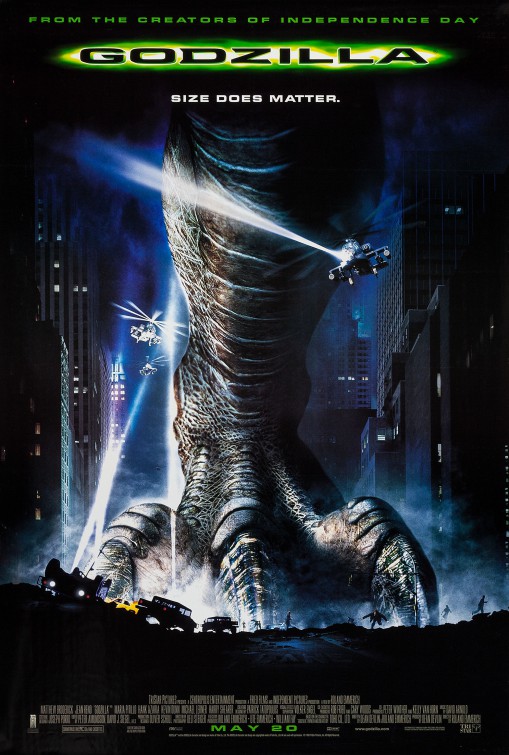
     Now the third option is less likely but I do know people who genuinely enjoy this film.  For the record, I did enjoy this film when I was a kid, so much to the point that for my 12th birthday I got nothing but merchandise from this movie and I watched the hell out of the VHS once I got it.  Yet, when I watch it now...let's just say time has not been kind to this version of Godzilla.  I don't even consider this film a guilty pleasure anymore, not like when I did a blog about the animated series that followed it.  This film was horribly received, currently ranking a 5.2/10 score on IMDB, a 25% score on Rotten Tomatoes and scorned by critics and long-time Godzilla fans alike back in 1998.  While the advertising for the film (including this trailer, which was brilliantly aired during the annual New Years Eve television special at about 11:58 PM) was solid, the general consensus is that the film itself isn't.  Since it does bear the name of "Godzilla," we're going to take a look at this movie again.  Now, I don't want to sound like I'm just jumping on a bandwagon, so when I sat down and watched it this afternoon, I went in with a mentality of, "Okay, we know the film is bad but is there anything good within?"
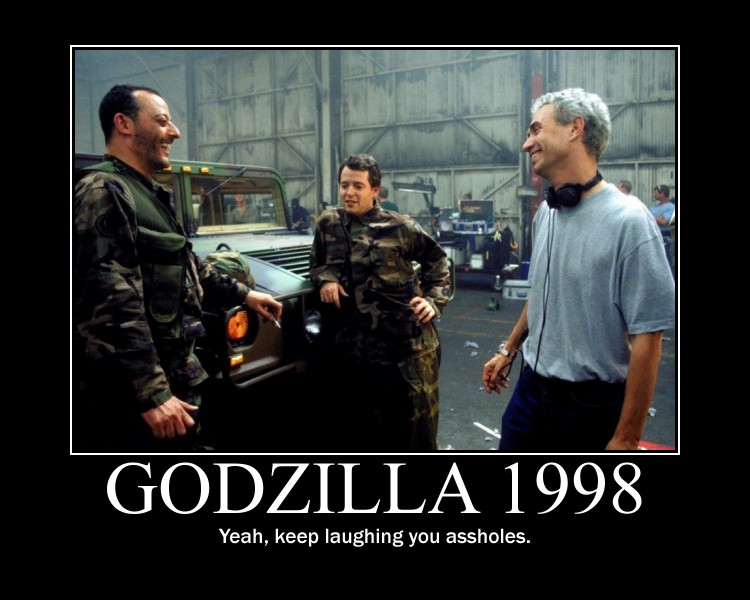
Okay, I got a good laugh out of this one.

      This film was director Roland Emmerich & producer Dean Devlin's follow up to their smash hit, 1996's Independence Day.  Originally Roland Emmerich had wanted to do an asteroid film, but Deep Impact and Armageddon were on the horizon, so he and Devlin got together and said, "Godzilla."  Since Tristar Studios had acquired the rights and been wanting to do an American take on the monster since the early 1990s (Stan Winston Studios at one point was attached to do the SFX), they were on board for totally reinventing the King Of The Monsters.  The duo reunited with Independence Day creature designer Patrick Tatopolous and gave him the daunting task of redesigning the classic kaiju.  After unveiling their design to the head honchos at Toho, the trio were met with a nervous silence and after being told to wait a day, Toho gave their blessing on the project.  This is really the only exposition you need on the history of the film.

      Alright, so let's get right down to it: is the movie really that bad?  Well, it's bad, but I don't know if I'd go so far as to say that it's truly as bad as everyone says it is.  Much like Transformers: Revenge Of The Fallen, it's full of problems but you won't really suffer from eye stigmata either.  Are there good things about it?  Hell, I know I'm in the minority here but one of the best things about this movie is Godzilla's appearance redesign.  I've been a fan of saurian creatures ever since I was five years old, so of course I don't mind if a monster that was originally conceived as a dinosaur mutated by nuclear radiation has a version that actually looks more saurian.  Granted, this is countered by the fact that in this version, Godzilla is not a dinosaur but in fact a mutated lizard from the French Polynesia and the CGI effects aren't up to par even for 1998, but still, of all the things about this movie, Tristar's Godzilla redesign is one of the few things that hold up.
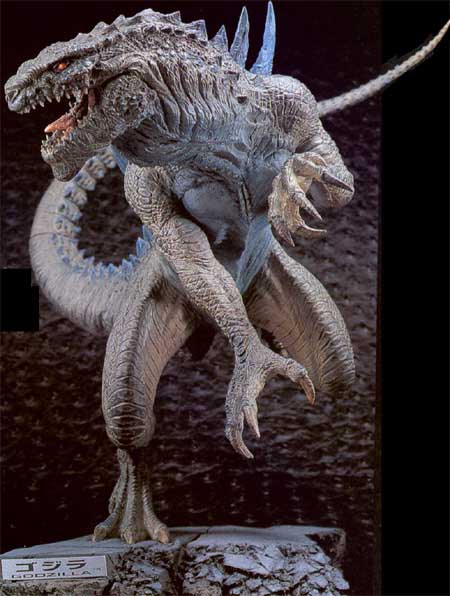
Nifty model kit of the redesign.

     I also still have the book of The Making Of "Godzilla," chronicling the behind the scenes mayhem to bring the new version of the world's biggest movie star to life.  Most people are quick to assume that all of the shots within the city featuring the military or of Godzilla were generated via CGI, but this isn't entirely true.  The part where Madison Square Garden blows up and Godzilla rises from what's left of it?  That's 1/24 scale model of MSG, which was taller than VFX Supervisor Volker Engel, being blown up on a soundstage with Kurt Carley in a Godzilla suit coming out of it.  How about where Godzilla has the fish truck in his jaws when he first arrives in Manhattan?  That's a 1/6 scale animatronic, which is slightly terrifying.  There are plenty of other practical FX shots in this movie and looking at this book upon watching the movie again, I feel really bad for the practical FX crew involved because while it may be a terrible movie, these guys and gals were working their assess off to try and make it look great.  However, in the end, I guess no matter how much hard work you put on making the quality bread of a shit sandwich, in the end you're still going to have a shit sandwich.
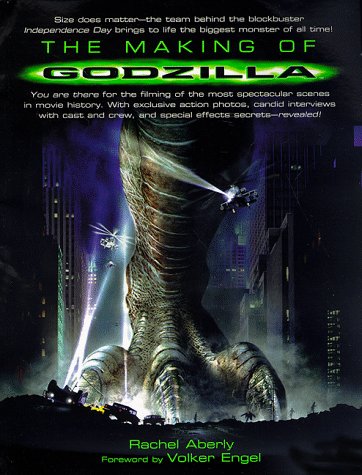

 I'd even recommend picking this book up on Amazon, for the mighty 3 cents plus shipping it'll cost you.

     How much of a shit sandwich, you ask?  Well, you know it's a bad sign when even the two good things about the film listed above have bad aspects to them.  In an old blog before I went on a bit of a hiatus, I had mentioned I wrote a video script of "5 Reasons Why Godzilla (98) Sucks" that never saw the light of day so I gave the condensed version.  Upon revisiting the film, those five reasons still hold firm today.  I'll elaborate on the bigger ones.

     Okay, this movie features one of the worst movie armies I have ever seen, actually causing more damage to New York than Godzilla does.  When I wrote my original "5 Reasons" script, I actually contacted a friend of mine who is in the United States Air Force to ask him exactly how accurate the representation of the Armed Forces were and below was his response.  I don't know if I can use my friend's name or not for whatever reason, so I'll omit that just in case:

     Cynic,

     Well, you are correct in your statement of a Roland Emmerich film being the last place to look for accuracy, but I'll assist you in an analysis of his "Godzilla" film, because that movie needs a kick in the ass whenever it can be provided.
     From what I recall of that abomination, nothing was really done right, both militarily and cinematically.  We in the Air Force do not fly the Apaches (the Army does) but we do work with them a lot on the MC-12, so we have a pretty good idea of how they work.
     About the needing permission to fire, it all depends on the rules of engagement for that particular mission.  Given the severity of a kaiju attack, I'd like to think they'd have it ironed out beforehand with, "If you get a shot at the damn thing, take it."  However, there may be extenuating circumstances, like if they had Godzilla in their sights but he was fornicating the Statue Of Liberty.  "Should I still take the shot?  I could destroy them both."  Usually Apaches, bombers and other attack aircraft are controlled so much by a guy on the ground called a FAC or JTAC (usually an Air Force officer working with the Army), but a Godzilla scenario would probably be a little different.
     The film's depiction of the agility of the Apaches also has me scratching my head.  I sincerely doubt that they wouldn't be able to weave all nimbly bimbly between buildings.  I know that no pilot would ever take his plane between skyscrapers and helicopters might be a little different but it still looks off when I picture it.
     There are two scenes in particular you asked about that are painfully, glaringly wrong:
     -When the swarm of Apaches are chasing the creature through the city, there's two things wrong here.  One, Apaches (well, nowadays at least) usually fly in a two-ship configuration.  You wouldn't have the mass number depicted in the film chasing a single target from one side.  Two, this scene has friendlies flying in front of one another while engaging the target.  To put it bluntly, it's a HUGE deal if you fire a rocket, missile or even a bullet with a friendly in front of you.  HUGE deal.
     -The scene where the Apaches fire upon the hollowed out building without confirming Godzilla is within is a huge no-no.  If you're going to fire, CONFIRM YOUR TARGET.  If there's a chance they'd destroy the city instead of Godzilla, it's likely they wouldn't fire until they could get a clearer shot at him.
     I also find the whole "heat-seekers can't lock" thing absurd.  Like I told you about that horrible Jurassic Park comic, heat seeking missiles are designed to go after airplane engines, so they need a target that's several hundred degrees in order to lock on.  I know that Godzilla was much faster in this version than the Japanese one, but still, if you can't hit a building sized monster, you're doing something wrong.
     "Godzilla" is a strange movie when it comes to the military aspect, especially when Roland Emmerich got it down fairly well with "Independence Day" and Michael Bay did a great job with the "Transformers" movies.  "Cloverfield" made it look more convincing than "Godzilla," even if you wouldn't have fighters flying that low over New York rooftops.  Hope this helps you with your script.

     Even if you know little to nothing about how armed forces tactics work, there's no doubt that the movie is lacking in other areas, like the acting and the script.  I'm not sure which one is truly at fault so I'm listing both.  I found that the only remotely convincing cast member in this movie was Jean Reno, who plays a French Secret Service agent who brings a team to New York to help take down Godzilla behind the military's back.  Matthew Broderick being the frontman in an action movie is one of the most bizarre things I've ever seen and for having a batch of actors being used to play scientists, they have some of the stupidest lines that should never come out of a scientist's mouth, the most glaring to me being, "An island, water on all sides..." As opposed to what, an island with water on a couple of sides?  The rest of the cast really isn't even worth mentioning, so we'll go to the next big thing.
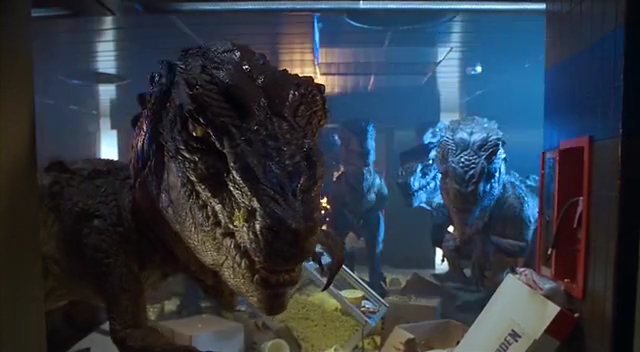
You...

      Yes, the Baby Godzillas.  I've always hated this part of the movie because it comes completely out of left field (Why would Nick think to buy pregnancy test in the first place?  Furthermore, how are pregnancy tests used on humans supposed to work on mutated reptiles?!), it's totally unnecessary and once they reach Madison Square Garden and the eggs start hatching, it suddenly becomes another movie.  Emmerich and Devlin swear up and down that any similarities to Jurassic Park were not intentional, but I have my doubts.  All this does is drag the film on, set up a sequel that never happened (theatrically) and lead into a finale that feels even more extended to the point where this two hour fifteen minute film feels longer than Lord Of The Rings: Return Of The King.  Actually, while we speak of the finale...


     While I am a fan of Godzilla's design in this movie, I don't like how he's so easily disposed of in this film.  Playing dead after getting torpedoed in the Hudson River, Godzilla emerges pheonix style from the remains of Madison Square Garden and chases after the human cast.  They lure him onto the Brooklyn Bridge where he gets caught in the suspension cables and some F-18s shoot him down.  Yup, after all we've been through, it just takes some suspension cables and twelve missiles to stop him.  I don't know if the film was meant to end with the destruction of Madison Square Garden and the test screen results felt that the story wasn't finished or what, but it sure feels that way.

     Okay, I think this review has gone on for a little too long (much like the film) and I'm getting tired.  Roland Emmerich's Godzila may have a neat looking monster, but the rest of the film is a bit of a chore to sit through because it throws watchable-but-not-particularly-entertaining material at us while taking itself oh so seriously.  Had the some of the dialogue and cast been tweaked, the Baby Godzilla's cut completely (although without them, we probably wouldn't have gotten the better animated series) and some of Godzilla's more traditional characteristics included (breathing atomic fire, not being killed by conventional weapons), this film probably could've been saved.  However, we're left with a film that can only really be enjoyed if you can completely turn off your brain and just roll with it.  Oh, well.  If absolutely nothing else, this movie is still better than Godzilla's Revenge.


*ulp* Sorry, I just threw up in my mouth a bit.
     -The Cynic

Sunday, March 30, 2014

Countdown To Godzilla: Godzilla vs Destoroyah

Original poster for Godzilla vs Destoroyah,which is actually pretty badass...
 
      Alright, here we are, still 47 days from Gareth Edwards' Godzilla and we're jumping a full 41 years ahead from the last Godzilla film we watched and tonight's subject matter is 1995's Godzilla vs Destoroyah, the final film in the Heisei, or second, series of Godzilla films.  For the record, this series of films do not have Godzilla being the savior of humanity like the later Showa series films.  Godzilla is more like an anti-hero in this series.  Sure, he'll whomp the shit out of another monster, but he'll still obliterate any civilization in his path.
 
     Okay, so upon watching this movie, it was a bit of a mistake on my part simply because there are characters who came from some of the previous Heisei entries that are present here and I had no idea what they were about, but that's nothing a little research couldn't fix.  Before I elaborate on the plot of this film, I'll fill you in on any missing details.
 
     There is a character in this film named Miki Saegusa, played by Megumi Odaka, who first debuted in 1989's Godzilla vs Biollante, that has psychic powers that she can use to communicate with or, in extreme cases, control Godzilla.  In 1993's Godzilla vs MechaGodzilla, she is a member of G-Force, a special anti-kaiju task force.  An egg is discovered that hatches into a baby Godzillasaurus and Godzilla seeks out this infant due to an unexplained psychic link and while the baby, now named "Baby Godzilla," is frightened of Godzilla at first, Miki convinces him to go with his new adoptive parent and the two creatures find home on a place called Birth Island.  By the time Godzilla vs Destoroyah rolls around, Baby Godzilla has become Godzilla Junior, looking more like Godzilla, only about half his height and with smaller spines.  Much like Godzilla's previous offspring, Minilla (or Minya), Godzilla Junior is a bit nicer than his adoptive father, actually saving Miki at one point in this movie.  Miki has formed a psychic bond with Godzilla Junior and has grown quite fond of Godzilla and Junior, despite her place of employment.  Okay, I think that gets us caught up, so let's move forward.
 
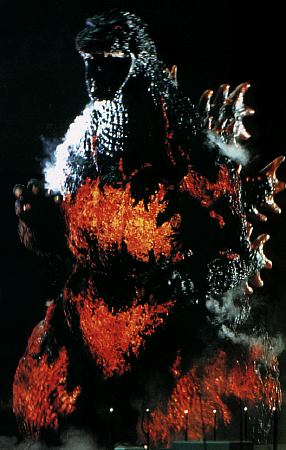
Godzilla's new look for the film.  Don't worry, it's gratuitous to the plot.
 
     Okay, so the movie starts out with Miki flying in a G-Force helicopter to find Birth Island a charred smoking rock.  Cut to Hong Kong where an orange glowing Godzilla surfaces in the bay, making the water steam and boil around him and he begins wreaking havoc on the city, spewing orange atomic fire instead of blue.  A G-Force meeting determines that Godzilla's heart is basically a nuclear reactor core that is currently in the process of melting down.  If the core goes critical, the entire world will be wiped out.  Miki grows concerned over the fate of Junior because her powers are fading and she can't get a mental lock on him.  G-Force recruits a scientist that has been working on an oxygen tampering experiment similar to the oxygen destroyer that killed the original Godzilla back in 1954 while using Godzilla Junior to try and lure Godzilla into a convenient location to dispose of him, but in doing so, the scientist accidentally helps create Destoroyah, a mutated Pre-Cambrian life form that came from a soil sample that was effected by the oxygen destroyer back in 1954.  A frantic race against time ensues to not only get rid of the Destoroyah creature, but to make sure that when Godzilla falls in his final battle, the Earth does not fall with him.
 
Destoroyah (aka Destroyer), one of the most unique Godzilla villains.
 
     Well, I'll just come right out and say that I liked this movie and I don't think I could truly do it justice without giving some stuff away soooo spoiler alert!  It may sound silly to put said alert on a review for a nearly twenty year old film, but I'm just covering my ass.  I won't go too much into the acting and what have you because the version I watched was dubbed over with English.  Naturally, the voice overs aren't terrible but they aren't great either.  I didn't mind because that's just par for the course with English dubbed Godzilla films and I won't get my manties in a twist over it.
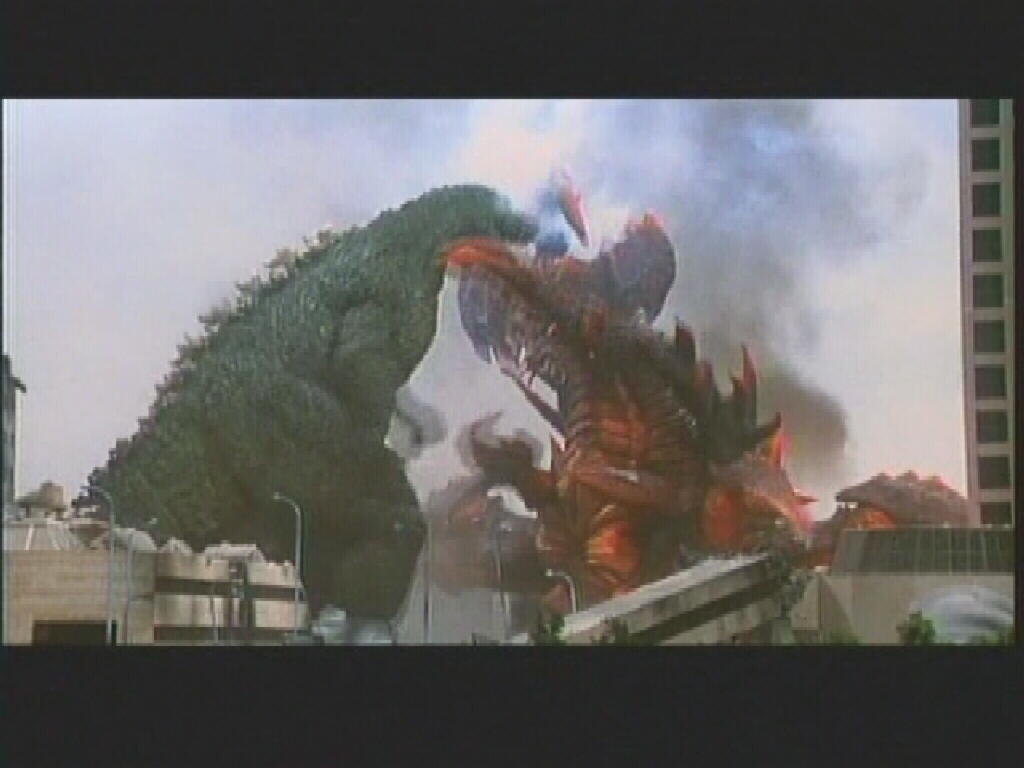
     Let's talk about Destoroyah.  This is one strange motherfucker because first it starts out as very tiny organisms that dissolve all the fish in the aquarium, then evolve into man-sized nightmares that have extendable Xenomorph-style mouths, then to even LARGER versions of that, and THEN they can combine into one Hugh Jazz version capable of shifting from flight form (as shown above) to ground form.  This guy does not fuck around, and why should he with a name like Destoroyah?  Now, in the film, he is referred to as "Destroyer," but from what I heard, Toho could not trademark that name, so they officially named it Destoroyah.  Besides, as James Rolfe pointed out, it's so much more fun to say Destoroyah, especially when you say it with gusto ("DESTOROYAAAAHHHHH!").  I will say this through, the scene where the Special Forces unit is fighting the Destoroyah crabs in the power plant will make you scratch your head and wonder if you're still watching a Godzilla movie because it really does feel like something more along the lines of Aliens or Predator.  I myself loved the practical effects used to bring the crabs to life and wish that we could see more of that in current films.

Godzilla Jr vs Destoroyah's ground form.
 
     Alright, here's the part of the review that makes me that asshole blabbermouth you always see at the theatre who gives away the ending so if you like what you've read thus far, stop reading and go watch this movie...still here?  Okay.
     With the plot revolving around Godzilla's body falling apart like whenever I try to build shelves for my man cave and the fact this was the final film in the Heisei series, you're probably wondering, "Soooo, Godzilla doesn't make it, does he?"  Well, he doesn't but he does.  This was the final film to be made before making way for an American Godzilla film and since the film went into production around Godzilla's 40th anniversary, Toho decided that it was time to put the big guy down.  This was a huge deal, enough that even CNN did a story on it.  During the final fight with Destoroyah, Godzilla Junior gets beaten to the point of near death.  After an unsuccessful attempt to revive Junior, Godzilla thinks he is dead and goes ballistic, unleashing everything he has on Destoroyah but also triggering his meltdown.  The Special Japanese Defense Forces use freezing weapons on both Godzilla and Destoroyah, smashing Destoroyah to pieces and keeping Godzilla's energy contained enough that the world is saved but Tokyo is now uninhabitable.  To see Godzilla's skin melt away as he lets out one last pitiful roar is actually very sad.  Check it out below.


     In case you're wondering what that ending bit was, the healthier looking version of Godzilla at the end is actually a revitalized Junior, absorbing the old Godzilla's radioactivity (so people can still live in Tokyo) which mutates him into an adult, showing in a not-so-subtle way that even if he is physically gone, Godzilla's legacy will carry on.
 
     Not really sure what else I can say about this one, aside from I really enjoyed it.  In closing, if you've enjoyed the other ones, Godzilla vs Destoroyah is not one that should be overlooked.  Great fight scenes, some of the best special effects to come out of the Toho films and a surprisingly emotional end, it was the send off that the King Of The Monsters earned.  Check back later as we look at...what?
 
Aw, shit.
 
     -The Cynic

Countdown To Godzilla: Dinosaurs Attack Follow-Up

     47 days until Godzilla!  Seems like maybe a couple months ago that we were reading the description for the SDCC12 teaser.  My, how time flies.

     Alright, I know I said I was going to be doing a review of 1984's The Return Of Godzilla, but my searches for a Blu-Ray/DVD copy on Amazon or a working torrent or reliable streaming site featuring the original Japanese cut turned up with empty hands.  So, in lieu of this, we're going to backtrack a bit and retread on the topic of Dinosaurs Attack!


     So, as you probably recall from my earlier blog, I had rather enjoyed DA, despite its absurdity, but questioned whether or not the story would flow better as a graphic novel instead of the rushed format the final issue had.  Well, I pre-ordered the graphic novel and was surprised to find that it was released a week ahead of schedule (so it arrived with my copy of Thor: The Dark World) and when I sat down to read it, it works much better as a graphic novel.  Not only because it breaks any barriers that would've been put up by the individual issues and the ending doesn't feel as rushed, but upon reading it again, the story takes place over a very short time frame so it helps if you read it in one sitting uninterrupted.  If you are wanting to look into DA, read it in this format.

     Now you're thinking, "Really?  You made a new blog just to tell us THAT?"  If that were the case, yeah, I'd be right there with you thinking, "Really clutching at straws there, Cynic."  Nah, the other, more important reason behind this blog is this...


     What you see here is an original retailer pack of Dinosaurs Attack cards from 1988.  A friend of mine, Professor Josh Turner, who is the curator for The Turner Museum Of Natural History in Cleburne, Texas, came into possession of a couple of these boxes from a friend who had a comic shop that unfortunately went under.  His friend was hoping that Prof. Turner would be able to hand out cards to any of the children attending the museum as souvenirs.  However, given the lack of scientific accuracy and the graphic content of the series, Josh decided against the idea and he's not overly keen on the series itself, considering how it vilifies even the most non-vilifiable dinosaurs (like the Hadrosaurs), so he messaged me after I posted my review asking if I'd be interested in having one of these.  Since I enjoyed the comics, I figured it'd be nice to have the cards that spawned them, so we traded my nearly 200 doubles from my Jurassic Park trading cards for a box of these puppies.


     The first picture there shows the full box of 48 packs, each containing five cards, one sticker and a piece of petrified bubble gum.  The gum was petrified back in 1988, so I'd hate to see what it's like now.  Anyway, the second picture is of the promotional poster for retailers to put up in their shop, so it's a nice little add on for the collection.  I wanted a set of the cards to look at and thumb through rather than constantly looking them up online, so my son and I began opening the packs and sorting out the cards and stickers.  By the time we had opened enough packs to make a complete set of 55 cards and 11 stickers, we were so close to making a second complete set that we decided to keep going.  After 41 packets, we stopped because we had enough to make two complete sets of cards and three complete sets of stickers, one set I gave to my son.  I messaged a fellow DA fan asking if he'd be interested in having a set of cards but he said no, so maybe I'll throw the extra set and the doubles up on eBay later this week or something.  If you're only missing one or two of the cards, I might be able to help you round out your set.

     I just wanted to share this little addition to the DA collection and now I feel obligated to get the original 1991 Eclipse comic just to round out the set.  I've got some laundry that needs folding but while I do that, I'm going to watch some material for the next review: the final film in the Heisei Godzilla series and what was intended to be the big guy's last hoorah, 1995's Godzilla vs Destoroyah.

-The Cynic

Friday, March 14, 2014

Countdown To Godzilla: Gojira Review


    Okay, here we are 63 days until Gareth Edwards' Godzilla hits theatres and today we're looking at the movie that started it all: 1954's Gojira.

     Japanese fishing boats begin disappearing near Odo Island, prompting the local shipping company to launch an investigation to try and figure out what happened.  As ships keep disappearing, a few survivors wash up on Odo Island, only to die immediately after, although one says that the ships are being sunk by a monster.  When a group of reporters witness the destruction first hand while investigating on Odo Island, a research team is sent to try and determine what is really going on.  It turns out that the dead sailor was right and a 50 meter tall monster the island elders call "Gojira" (American translation is "Godzilla") is to blame.  More investigation uncovers that Gojira was created by the radiation from nuclear weapons.  Soon, the creature arrives in Tokyo and both the military and Tokyo's residents realize that the creature is as powerful as the nuclear tests that spawned him, putting the fate of their country (and possibly the world) at stake.


Classic image of Gojira/Godzilla wreaking havoc.


     Okay, background!  On August 6th, 1945, the Allied Forces dropped an atomic bomb on the town of Hiroshima, Japan after the United States called for a surrender of Japanese Forces in the last stages of World War II, threatening "prompt and utter destruction" if they didn't.  Three days after Hiroshima was bombed, another Japanese city, Nagasaki, received the same treatment.  Japan would then announce its surrender to the Allied Forces on August 15th and sign the instrument of surrender on September 2nd, thus ending World War II.  Not surprisingly, the horrors of such events have never truly gone away and the events were still fresh in director Ishiro Honda & producer Tomoyuki Tanaka's memories when they began work on Gojira.  The film has a background story as interesting as the film itself, as this was supposed to be a completely different project altogether, but that project fell apart and Toho Studios just said, "Guys, you have production time to use, just make a movie.  Any movie!"  Tanaka had recently read of the Daigo FukuryÅ« Maru (The Lucky Dragon), a fishing boat that had been exposed to radiation by the thermonuclear device test in the Bikini Atoll in March 1st, 1954 and was inspired by the American film The Beast From 20,000 Fathoms (rightfully so, damn good film) to bring in the monster-movie angle.  Sci-fi novelist Shigeru Kayama wrote the original story while Honda and Takeo Murata wrote the screenplay.  Toho held a contest to determine the name of the monster, the winner being "Gojira," a combination of the Japanese words for gorilla and whale.  I could go on, but we got a movie to review!


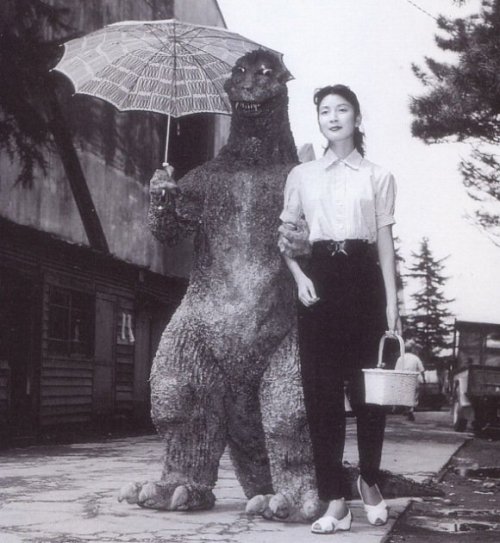
Haruo Nakajima (in suit) and Momoko Kochi (Emiko) having fun on the set in 1954.

     Okay, I'll admit it.  I'd never seen this version of the film before, only the American 1956 version Godzilla: King Of The Monsters.  Hell, there's a LOT of the Godzilla movies I still haven't seen.  I had always wanted to see the original Japanese cut of the film but as a kid I was never able to find it.  Just as well, because had I watched this version when I had the VHS of King Of The Monsters, I probably wouldn't appreciate Gojira and its themes as much as I do now.  Most people see Gojira/Godzilla as something of a joke, a goofy cheap effect that does nothing but fight and smash other cheap effects.  These kind of people need to sit down and watch Gojira, as this film is an allegory of the horrors of nuclear testing made by the people who experienced it first hand.  The tone of this film is incredibly serious, treating Gojira's attack as if it were something akin to a natural disaster.  With most of the other Godzilla films, if you see him crashing through a city obliterating civilization, you think to yourself, "Okay, just waiting for the other monster," or, "Look at the effects!  LOL!"  With Gojira, there's that feeling of hope being lost while looking at the burning skyline of Tokyo or as the military's defenses prove to be not even distractions to the creature as the intent was to show the creature as the atomic bomb personified.  This was a tone that would be lost to the series for thirty years until 1984's Return Of Godzilla (or Godzilla: 1985, if you're watching the American version).

This part, a woman holding her children amidst the rampage assuring her children they'll soon be reunited with their father in the afterlife, is especially haunting.
 
      Now it's hard for me to tell if the actor's performances were good, scene chewing or whatever simply because this is an older film with (presumably) older acting styles and since the version I watched was Japanese audio with English subtitles, I spent more time reading the dialogue rather than taking in the intensity of any performances.  That being said, I found the story flowed well, keeping the audience engaged in the characters enough that you aren't just looking down at your watch waiting for Gojira to arrive.  The creature doesn't reveal itself until about 28 minutes into the film (if I recall correctly) and those 28 minutes are not a chore to sit through.  I do not recall if the love triangle between Emiko, Hideto Ogata (Akira Takarada) and Dr. Daisuke Serizawa (Akihiko Hirata) was in the King Of The Monsters version, but it didn't feel forced here, providing a path to a crucial plot development that could save humanity but destroy it alike.  I also was glad to see that not every person was all for obliterating Gojira on sight (despite the sense it would make).  Emiko's father, Dr. Kyohei Tamane (Takashi Shimura) flat out asks the question, "Instead of simply trying to find ways of killing it, why don't we focus on what's keeping it alive?"  These questions go on unheard, but blame a guy for trying.  Perhaps if he had actually gotten his paleontology right earlier in the film, people would've been more likely to listen (dinosaurs roaming the Earth two million years ago?  What kind of scientist are you?).

Gojira easily working his way through Tokyo's electric defense.
 
     Background history of the film?  Check.  Acting and character discussion?  Brief, but check, so let's talk effects.  You might think that there wouldn't be much to say about a guy in a suit stepping on miniatures, but you'd be wrong.  Being in the Gojira suit was apparently Hell.  First off, the very first suit that was made was so heavy and stiff that it proved unusable.  Even with the redesigned suit, Nakajima would overheat and become very dehydrated and exhausted, actually passing out at one point.  Even with a valve to drain sweat from the suit, the Gojira suit could only be worn for three minutes to avoid suffocation (makes Mark "Crash" McCreary & John Rosengrant's experiences in the Jurassic Park Velociraptor suits sound downright pleasant).  However, Nakajima must've exuded enough testosterone to throw a Herculian laugh at these setbacks as he continued to portray the creature until he retired in 1972.  At first the idea was tossed around to film Gojira in color, but Toho said "Eff that," because they wanted the nighttime attacks on Tokyo to give Gojira a more frightening and mysterious look, shrouding many of his details in darkness and (in my opinion, anyway) preventing the audience from getting a truly great look at the monster in full detail.  At it turns out, filming in black and white also hid some of the wires used in the effects shots and making it feel less like you're watching a guy in a rubber suit and more like you're seeing the story as it unfolds.

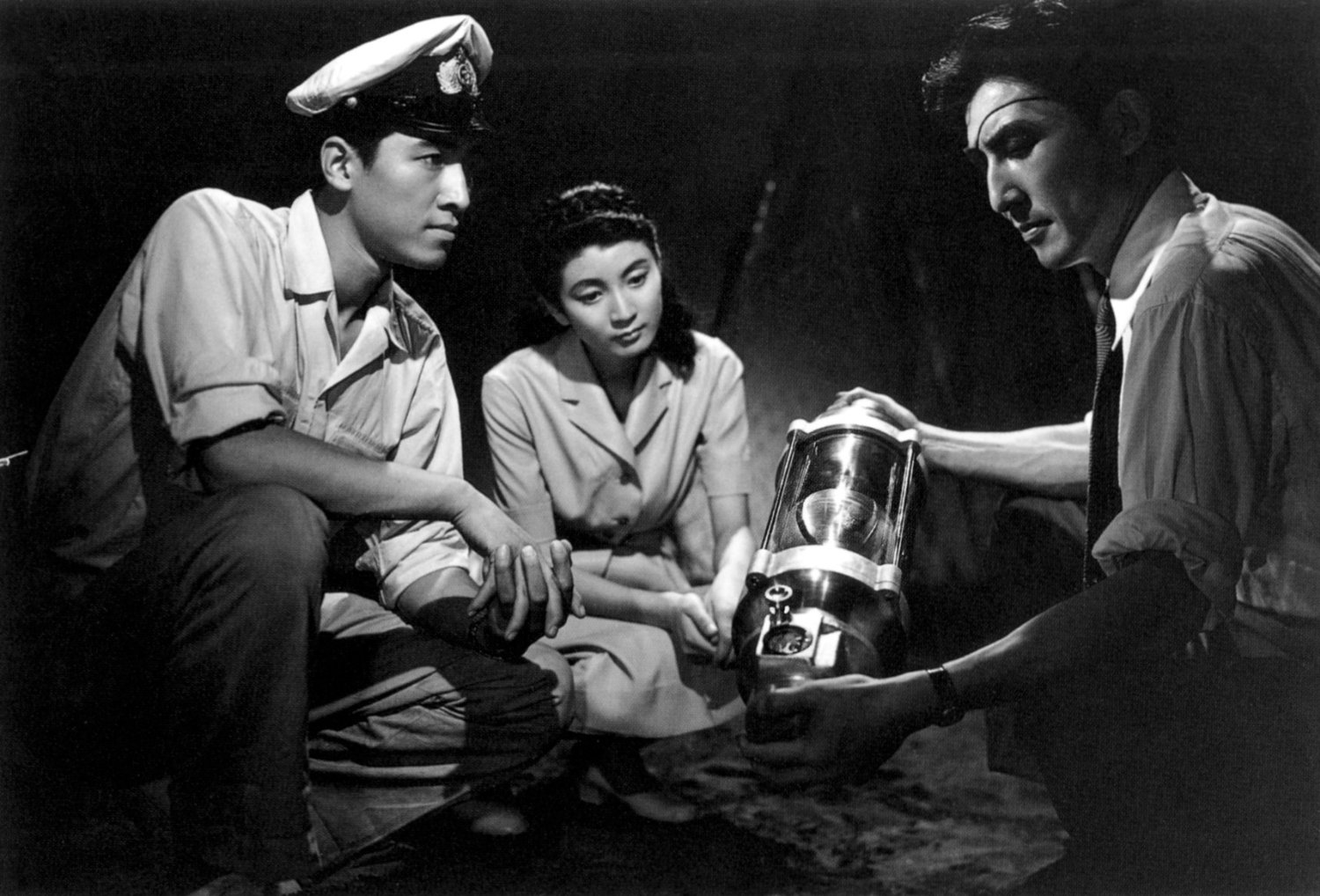
Ogata, Emiko & Serizawa with the device to use against Gojira.
 
     I'm not saying that I'm doing cartwheels saying that this is the best movie ever, but there's little doubt why fans will swear up, down, left, right and center that this is the best film in the Godzilla series and quite possibly the best kaiju (Japanese for "giant beast") film.  I'm used to this film gaining nothing but praise, so I found it surprising when I learned that upon its initial release in Japan, Gojira was received with rather nasty feedback, accusing the film of cashing in on the misery that their homeland had incurred during World War II as well as the Diago Fukuryu Maru incident, labeling it, as Honda told Tokyo Journal, "Grotesque junk, something that you'd spit up," much like how I've said why I'll never watch World Trade Center.  Despite the initial negativity towards the film, Gojira would go on to win the 1954 Japan Movie Association Award for Special Effects and be nominated for Best Picture, only to lose to Seven Samurai, which, from what I've heard, is nothing to be ashamed of.  Thankfully, as time went on, Japan (and the rest of the world) would grow to appreciate the film more and it reached such popularity that it went on to spawn an astonishing 27 sequels in Japan alone, not to mention the American releases of Godzilla: King Of The Monsters, the 1998 trainwreck by Roland Emmerich & Dean Devlin and, of course, the upcoming Gareth Edwards' version.  The monster's legacy is not limited to film either as there are multiple games, novels and comics sporting the giant monster.

Including a recent arc from IDW featuring a cameo from the 1998 creature, which I still like.  The creature, I mean.  Screw the movie.

     Gojira is one of those movies that its hard to talk about without sounding like you're just parroting what has already been said about it, but at the same time, it's fucking Gojira.  If you consider yourself a kaiju fan in any way, shape or form, go watch this movie as the kaiju genre would be nothing without it.  Perhaps one day I'll watch both this and Godzila: King Of The Monsters to compare the two.
     Well, I hope you enjoyed reading my take on the classic Gojira.  As fun as it would be to pull a Cinemassacre and review every Godzilla film ever made, a) it's been done and b) many of them have a more light hearted tone than what I feel the upcoming film will have.  Check back later as we jump forward thirty years and look at the direct sequel and beginning of the Heisei series, The Return Of Godzilla.

-The Cynic

Wednesday, February 26, 2014

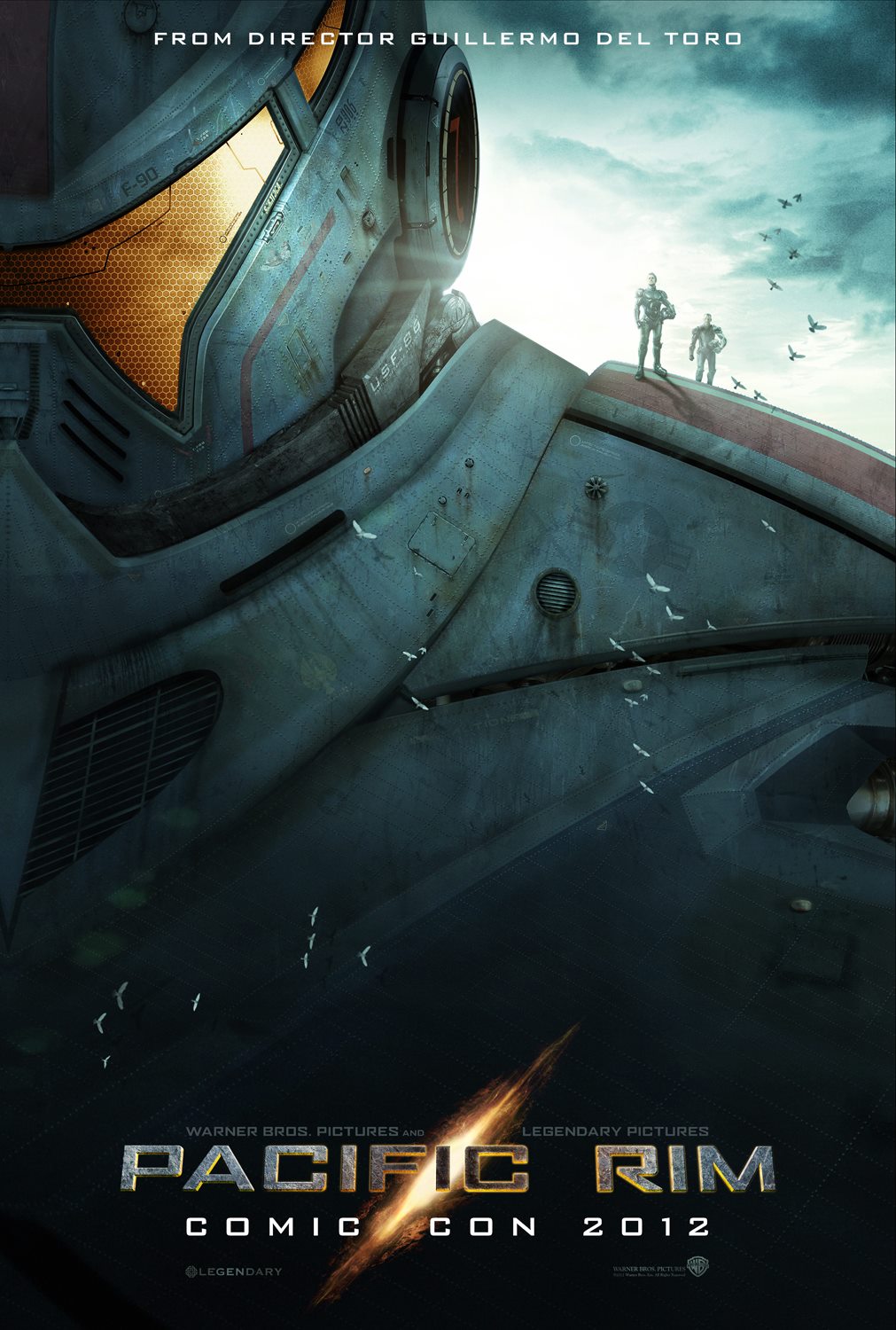
Countdown To Godzilla: Pacific Rim Review


     Hey, everyone!  Here we are 79 days until May 16th when Gareth Edward's Godzilla hits the theaters with a vengeance.  Yesterday the internet was presented with a new trailer for the film (which helped us nerds ease the sadness of the loss of Ghostbusters writer/star Harold Ramis the day before) and so...what do you mean you haven't seen it?  Here, check it out below.  I'll wait.


     Okay, now that we've gotten that out of the way and we've wiped the drool from our gaping mouths, upon seeing that I was thinking to myself, "Damn, I gotta get on that next review.  May'll be here before we know it!"  After the kids had gone off to bed, I parked my ass down and finally got around to watching Guillermo del Toro's Pacific Rim.


     Gypsy Danger vs Knifehead

     The plot of Pacific Rim is that giant creatures begin emerging from the Pacific Ocean called Kaiju (Japanese for 'Giant Beast').  The first creature takes six days to kill using conventional military weapons.  As more Kaiju show up, the world realizes that their tanks and jets aren't going to cut it, so the nations set aside their differences and pool their resources to make giant robots named Jaegers (German for 'Hunter') to combat this threat.  At first the Jaegers are a monumental success and the Kaiju almost becomes something of a joke to humanity, but then the Kaiju begin adapting to the Jaegers and humanity's future is put into question.

     To be honest, Pacific Rim was one of the big summer '13 releases where try as the trailers might, it just couldn't draw me in enough to buy a ticket  (the other was Man Of Steel)Sure, I like giant monster movies and creature features in general but for whatever reason, Pacific Rim just wasn't doing it for me.  The film's theatrical run came and went and feedback from my friends varied from "Very articulate and well thought out" to "so horribly stupid that it's enjoyable, much like the Mario Brothers movie."  I still hummed and hawed about it once the film hit home release, but then I watched the Honest Trailer for it and decided, "Okay, let's give it a shot for Countdown To Godzilla."  Minor spoiler alert.


Heimdall and Jax in the same movie?  Man, the Kaiju are so screwed.
      Well, where to start?  Let's go with the actors.  At first, I groaned a little at Raleigh Becket's (Charlie Hunnam of Sons Of Anarchy fame) narration at the beginning of the movie, feeling that it lacked...enthusiasm, for the lack of better term.  I kept an open mind though because some actors work better on screen then they do with voice overs and, hey, the narration wasn't as bad as The Last Airbender.  It wasn't until Raleigh's backstory was told that I understood why he lacked enthusiasm (his brother got killed during the fight with Knifehead) and was more forgiving with that.  Hey, how upbeat would you be if your brother got killed while you were neurally connected?  The rest of the cast does a decent enough job with their roles, although I'd be lying if I said that the switches between English and Chinese during Mako Mori's (Rinko Kikuchi) lines were a tad distracting because the film never really gave a reason for it.  If it was established that Mako's English was limited, I'd shrug it off but I never got that impression.  As far as Idris Elba's role as Commander Pentecost goes, it's not like it was phoned in but I didn't find myself clenching my fists and thinking, "Fuck yeah," whenever he was onscreen, unlike when I watch the Thor films.  The cameos from del Toro alumni Ron Perlman as a Kaiju Organ Black Market dealer and Ellen McClain in her GLaDOS voice from the Portal game series were welcome additions.
Maquette for the Kaiju "Otachi."
      Okay, not surprisingly, this movie gives enough to its human cast so that the audience doesn't get up and leave during the slower scenes and tosses everything else at the special effects department, and I don't just mean the CGI.  Legacy Effects (formed by Stan Winston Studio almuni Lindsay Macgowen, Shane Mahan, Alan Scott and John Rosengrant) contributed the practical effects to the film, giving amazing detail to the Kaiju skin parasites and body parts in Dr. Newton Geiszler's (Charlie Day) lab, amongst others.  As far as the CGI goes, Industrial Light & Magic really outdid themselves on this film, making their efforts from the Transformers and Pirates Of The Caribbean films look cheap in comparison.  The first appearance of the Kaiju is an image that'll give you chills with how detailed everything looks as it rips apart the Golden Gate Bridge.  I don't think the rest of the Kaiju shots quite live up to that first one, but they all look quite remarkable.
*Shudders*
       Am I sorry I didn't catch this one in the theaters?  No, not really.  Pacific Rim doesn't really blow your mind with its storytelling but I don't think it wants to.  It wants you to be a kid again, enjoy giant robots feeding giant monsters knuckle sandwiches and depart from the dark, gritty Christopher Nolan-esque style blockbusters seem to be taking lately.  While some parts closer to the end of the film felt a little too Independence Day for my liking, overall Pacific Rim gets an "okay" from yours truly.  The film may run a little longer than it probably should but it is far from a waste of time.  That being said, I don't think I'm on board for that potential sequel that Guillermo del Toro has talked about (the ending doesn't really leave an opening for a sequel, but hey, neither did Independence Day and look how that's going).  If you dig CGI spectacle creature features, put this in your movie que.  If nothing else, it's a helluva lot better than Q: The Winged Serpent was.
     Check back in a little while for our next entry in Countdown To Godzilla, where we look at the one that started it all: 1954's Gojira.
-The Cynic

Saturday, February 1, 2014

Countdown To Godzilla: Q The Winged Serpent Review

Theatrical poster painted by the awesome Boris Vallejo.
 
     Here we are, once again looking at a giant monster media while we await Godzilla's release.  Last time, we looked at IDW's publication of Dinosaurs Attack!. Today, we're going back even further in time to 1982 to look at the film Q, or more commonly known as Q: The Winged Serpent.
     The movie starts off with some creepy pervert window washer getting his head bitten off by some unseen creature.  As the police investigate, Shepard (David Carrodine) suggests out of frustration that maybe the washer's head came loose and fell off while he tries to connect this latest murder to the string of mutilations that have occurred..  Meanwhile, a sleazeball small-time crook named Quinn (Michael Moriarty) abandons his colleagues in the midst of a heist and loses the merchandise.  While on the run trying to hide, he stumbles upon the creature's nest and tries to use his knowledge of the lair as a "Get Out Of Jail Free" card once he gets taken in by the police.  After some unorthodox investigations, Shepard comes to the conclusion that the mutilations were ritual sacrifices done by a modern day Aztec worshipper that has brought back the ancient god Quetzalcoatl and now Shepard and Quinn have to devise a plan to stop the creature before it can kill again and breed.
 
The title creature, after having been fed a few bullets.
 
     This film seems to be one of those movies that is making me stall at the keyboard trying to figure out what to say about it, which is nothing short of frustrating.  Even if doing reviews is just a hobby, I try to word it the best that I can as if I were being paid for doing so...and then a movie like this comes along that leaves you feeling like you don't have a lot to work with.  Was it a masterpiece?  No but I wouldn't go so far as to say that it was a total disaster either.  If you're into scenery chewing, this movie is right up your alley.  Carrodine handles the situation very calmly and open minded unlike most other monster movies that have the authority figures going, "Hogwash!  There's no such thing as monsters!"  Perhaps Carrodine merely nips at the scenery, come to think of it.  This is especially true when in the company of co-stars Moriarty and Richard Roundtree.  Whenever these two are on screen, I swear if you look close enough, you can see chunks of the decorum between their teeth.

Mmmm, brick...
 
     Alright, what good is a monster movie review if we don"t talk about the monster?  The special effects in Q are pretty decent, with the creature being brought to life via a leg puppet prop and stop motion animation by Randy Cook (whose other works include The Thing and Ghostbusters, amongst others) and David Allen.  Now I know a lot of people groan with stop motion animation but I seem to be one of the few people who find it creepier than CGI probably because it looks so jerky and unnatural, making the monsters it animates seem that much more not of this world.  This movie also takes the same approach that Jaws & Predator did where you do not get a clear look at the creature until at least 45 minutes into the movie.  I've always liked this approach just as long as the rest of the movie can tide you over until the creature is on screen, which I don't necessarily felt that Q did.  To tell the truth, Q is one of those movies where I found the production of the film more interesting than the film itself.  I guess in the end, I'd say this movie was okay but you'd probably really have to twist my arm to get me to recommend it to anyone.  I know this is kind of an odd way to end a review, but I really don't know what else to say about it.
     Check back in a while when we take a look at Guillermo del Toro's Kaiju smackdown romp, Pacific Rim.  Hopefully it'll give me more to work with.

-The Cynic

Saturday, January 11, 2014

Countdown To Godzilla: Dinosaurs Attack Comic Review

Uh, guys?  The scary eyes are BEHIND you.

     This probably comes at absolutely no surprise to any of you, but…I like giant movie monsters, and Gareth Edwards’ upcoming Godzilla film is no doubt the, forgive the wording, King of my “Upcoming Must See Films” list.  My excitement for this film has been building for quite some time, mostly due to the hype built around the 2012 San Diego Comic Con teaser trailer that never found its way online until October 2013…briefly.  I was able to see the trailer a few times before it was taken down and it sent my anticipation into almost foaming-at-the-mouth levels.  That being said, I’m going to do a "Countdown To Godzilla," where I look at media involving giant monsters while I boil in my own anticipation of May 2014’s release.  What part of, “Shut up and take my money” does Warner Brothers & Legendary Studios not understand?!

What an awesome shot.

     In our first episode of Countdown To Godzilla, we’re going to head back to 1988 (well, sorta) to look at Dinosaurs Attack!.  In case you need some background history on this subject, I aim to please.
     In 1962, Topps released a series of trading cards called The Civil War News, the brain child of Len Brown and Woody Gelman who created the cards using a similar series from the 1930s, The Horrors Of War, as a template, depicting violent imagery on the front and journal-like exposition on the back.  These cards were very graphic, very violent and very successful.  In the same year, Topps (under the alias of “Bubbles Inc”) launched the infamous Mars Attacks! series, which combined the violent nature of The Civil War with the popular 50s-60s trend of invaders from outer space attacking Earth.  Oddly enough, these were the ones to feel the wrath of parents that felt the cards were too violent and were actually pulled from the shelves for a time.  In 1965, Topps tried again with a series called Battle, which depicted World War II battle scenes but the series flopped and this was the last of the Topps/Brown/Gelman combinations.
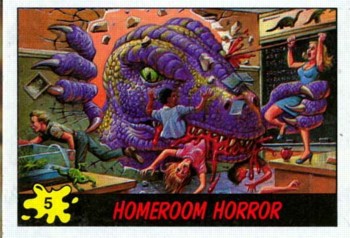
     In 1987, Topps said, “Fuck it, let’s try again…with DINOSAURS!  Writer Gary Gerani and artists Herb Trempe & Earl Norem teamed up for Dinosaurs Attack!, a 55-card & 11-sticker series that brought back the “freewheeling ‘bad taste’ graphics and humor,” as Gerani described it.

Pictured above:  DA in a nutshell.

The story of DA is as follows (uh, guess I better go out on a limb just to cover my own ass and say, “SPOILERS!”): Dr. Elias Thorne and his wife Helen have created a Time Scanner on the space station Prometheus.  The Time Scanner creates a window to the past, which Dr. Thorne plans on using to answer the age old question of how the dinosaurs went extinct.  However, when the Time Scanner is fired up, something goes awry and the screen is filled with a pair of large reptilian eyes.  When this happens, dinosaurs begin materializing out of thin air and attacking the human race.  Even creatures documented as docile herbivores become blood-thirsty monsters that devour anyone in their path.  The planet falls into absolute chaos as the human population faces mass casualties and the world’s military forces are unable to hold them back.  While Dr. Thorne tries to come up with a solution, he has a dream where he is visited by a creature called “The Saurian,” who informs him that the dinosaurs are under the control of something called “The Supreme Monstrosity,” who wishes for the planet to be put back under the rule of the dinosaur.  Once Dr. Thorne comes up with a solution to send the dinosaurs back to their own time, a giant fiery hand comes through the screen, grabs him and pulls him into another dimension.  The hand belongs to the Supreme Monstrosity, or “Dino Satan,” as some fans call him, and Dr. Thorne tells his wife to throw the switch.  She does, which hurtles the dinosaurs back to the Mesozoic, some of them not entirely intact, but in doing so initiates the Prometheus’ self destruct and traps Elias in with Dino Satan.  Elias dies but Helen manages to escape from the Prometheus and upon returning to Earth, she comes to the conclusion that what wiped out the dinosaurs was the human race.
While the cards may not have broken serious ground in the market, hardcore collectors absolutely LOVED them and the series was popular enough that Eclipse Comics was going to launch a comic series that told the story of the cards.  However, that story was cancelled after just one issue and Dinosaurs Attack! seemed to fade away.

The original issue of DA, which actually shouldn't set you back too much on eBay.

            Fast forward to 2013.  Having crashed and burned with their Jurassic Park comics, IDW Publishing, who, at the time of this blog’s production, had the rights to Mars Attacks! and was crossing it over with every other IDW property possible, decided to take a break from Martians and focused their attention of finishing what Eclipse started all those years ago by not only completing the Dinosaurs Attack! story, but by also expanding the story from the initial 3-issue run to a new 5-issue run.  Now, when I first heard about this, I was like, “Okay, whatever.”  My neighbors had shown me a few of the cards when I was a kid and I even had a couple of the stickers on my headboard, but I didn’t go absolutely crazy over them because I honestly wasn’t too keen on the over-the-top violence seeing as how I liked dinosaurs as I saw them in the science books.  In high school, I somehow rediscovered Dinosaurs Attack! and the knowledge of the series’ existence has stuck with me since I was able to appreciate it more.  As an adult, my curiosity got the better of me and I decided to look into IDW’s Dinosaurs Attack!
            Upon reading the five issue series, one of the first things that really stood out to me was just how little of the cards were used to draw source material from.  Only 29 of the 55 cards are referenced to/included in the series, giving writer Gary Gerani enough breathing room to flesh out the characters on the Prometheus and in the Ohio News Station so that you aren’t just rooting for the dinosaurs smashing stuff and eating people but for the people who are actually trying to do something about the dinosaurmageddon.  Some minor changes are made to the Thornes as well.  In the cards, they were married but in the comics, they are recently divorced and Helen is trying to shut down the TimeScan project not because she’s a bitter ex-wife but because she is genuinely concerned of the ethics of a project like this.  This also allows for some mystery whodunit moments during the dinosaur invasion as the crew of the Prometheus tries to figure out if all of this is caused by Elias’ ESP or if something more sinister is at work.
            The comics also do a very good job of keeping the spirit of the card series going, seeing as how both have the same writer and artists.  Earl Norem returns to paint any scenes with the dinosaurs reeking havoc while Herb Trimpe handles the human-based art.  Ordinarily I find it frustrating when a comic bounces back forth from artist to artist (the final issue of Marvel Zombies vs The Army Of Darkness was REALLY bad for this) but with the world of DA, this works, and it truly disappointed me in issue 5 when Dino-Satan appeared and was handdrawn instead of painted.  Of ALL the things that should’ve been painted, Dino-Satan was the big one.


 *Sigh* It's just not the same...

     However, to make up for it a couple of issues end with a cliffhanger style similar to the end of the old Adam West Batman series, featuring corny lines such as, “New Thrills, New Surprises…As The Fantastic Dinosaur Invasion Continues Unabated!’ Or “With Selected Scenes In Super-Realistic DINOSCOPE” over images not only recycled from the card series but original artwork that makes me wonder if it was done just for the comics or if they were intended to be in the cards but never saw the light of day until now.
            One last good thing that I want to touch base on here is that much like the cards, the comics of DA throws in nods and references to other “Prehistoric Animals vs. Modern Man” media.  For example, those two things trashing Italy in issue 2?  Those are the creatures from The Giant Behemoth and The Beast From 20,000 Fathoms, respectively (couldn't find the comic art online, but here's the card for reference).  Issue #4 has a slew of references on a single page.  Look at these two panels: There’s Godzilla, Gorgo, the Rhedosaur (Beast From 20,000 Fathoms), every four legged lizard looks like they came from the 1960s version of The Lost World, that dragon-thing looks like Reptilicus, there’s Rodan and Gertie The Dinosaur, of all things!  Was NOT expecting her to show up here.
            All this being said, there were a couple of things that I DIDN’T like about DA.  I had already mentioned that I was really disappointed that Dino-Satan was not painted, but there was something else that bothered me.  When Elias is visited by The Saurian in his dreams, in the cards he looked more like the humanoid Troodon model that theorized what dinosaurs would look like had they not gone extinct.  Here, he looks more like a skinnier version of The Lizard from The Amazing Spider-Man.

 
Dr. Connors?  Is that you?

     I also found that he comes off as much condescending as he is helpful and I had really hoped IDW ran with this and had it turn out that The Saurian was actually Dino-Satan.  It also didn’t help that Dino-Satan doesn’t speak so this lack of banter once he grabs Elias, in combination with the handdrawn art style and green instead of red skin, actually makes him less menacing and more…derpy.
            DA also seems to have troubles with pacing, if you are reading it from the individual issues.  The first issue is mostly exposition and character setup, making the first issue seem like a bit of a bore if you’re expecting them to deliver on the title of Dinosaurs Attack right from the get-go.  Issues 2 through 4 seem to do a pretty good job of balancing character interaction with the death and chaos and that’s where this series really shines.  Issue 5 seems really rushed as if the writer and artists were having fun with the ideas they had but the powers that be said, “Okay guys, you seriously gotta wrap this up” so the climax with Dino-Satan feel like it was just jammed together to meet a deadline.  I’m hoping that if you were to read DA in a trade format that it’ll blend together a bit more seamlessly, but we’ll have to wait until March and see (which I intend to get, by the way).           
     Basically, if you were to ask if I would recommend this comic to anyone, I would probably suggest that they acquaint themselves with the card series beforehand, just so they know what they’re getting into.  Because if you go into DA expecting something with little things like scientific accuracy, you’ll HATE it.  Now, would I want to see a sequel?  Actually, yes.  Gary Gerani had come up with a sequel idea, but since the original DA didn’t quite take off it never saw the light of day, save for a bonus card that came with the original Eclipse comic issue so it’d be nice if, much like the first arc, IDW was able to finish that.
            Of course, the idea has been kicked around for some time of a DA movie.  When Tim Burton had acquired the rights to Mars Attacks, he also had the rights to DA with the intent of making that film first.  However, the release of Jurassic Park crushed those ideas, which included both a live action and animated series, so Mars Attacks got to see the light of day…for all the good that did for the film.  Really, I think DA’s time to be a film has come and gone.  The series is too much of a throwback to the man vs. prehistoric monsters movies of old to work nowadays as a film, in my opinion.  DA doesn’t take itself seriously and has many nods to the old stop motion, guys-in-suits and trick photography days that in a world rampant with CGI-fests and dark, gritty Christopher Nolan reboots, it just wouldn’t feel the same and in the end, probably not worth the efforts of both the studios and the filmmakers financially.  If this was 1989 and the old special effects technologies were still being used, then yeah, I’d be all for it…but it’s not.  I know nothing is sacred in entertainment anymore, but DA works well as a tongue-in-cheek card and comic series.  Just leave it at that.
            And that concludes my review of Dinosaurs Attack!  Check back in a little bit for the next episode of Countdown To Godzilla, where we’ll be looking at the David Carrodine film, Q: The Winged Serpent.

-The Cynic